
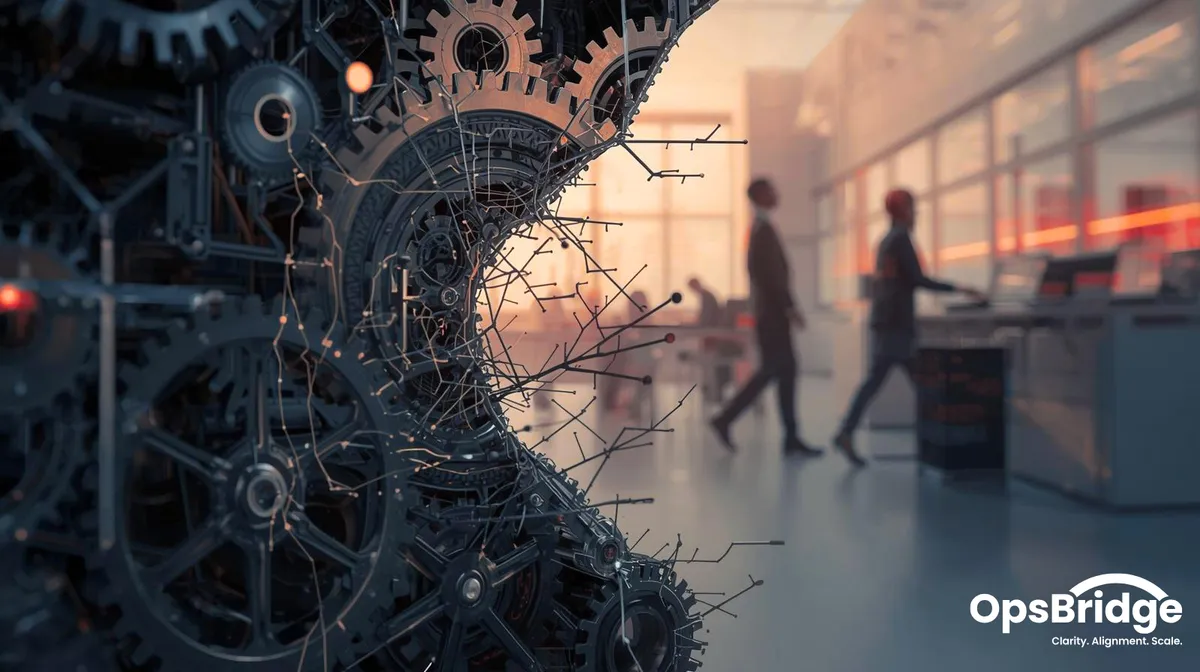
AI Could Be Making Organizations Worse Before They Get Better… and Most Don’t Realize It.
AI is supposed to make organizations more efficient. In practice, it often exposes underlying issues in workflows, decision-making, and execution that were already there, but were easier to ignore when work moved more slowly.
Not because the technology isn’t capable, but because it doesn’t always fit cleanly into how work actually happens. It often sits alongside existing processes rather than inside them, producing output that looks useful but doesn’t consistently translate into clearer decisions or better execution.
That part isn’t new. What is changing is what happens once speed is introduced.
Once you introduce speed into a system that isn’t fully working, you start to see what was always there, just easier to ignore. Work that used to feel “good enough” starts to feel off, decisions that were previously delayed are forced earlier, and outputs that once passed without question begin to get challenged. Not because the work itself has changed, but because there’s less room to work around it
When Speed Meets Structure
AI isn’t just accelerating work, it’s changing the conditions under which that work operates.
When things move more slowly, gaps can be absorbed — rightly or wrongly. People step in, clarify, adjust, and bridge what hasn’t been explicitly defined. Over time, those adjustments become part of how the system functions, even if no one would describe them that way.
Speed through AI removes that flexibility.
Without it, unclear ownership, incomplete handoffs, or loosely defined processes don’t just exist in the background, they start to interrupt flow more directly. What used to be manageable becomes visible in how work stalls, loops, or needs to be revisited.
The impact of AI adding speed is that it removes the time we’ve been relying on to make the work flow.
A More Useful Way to Evaluate Impact
So instead of asking “how can we use AI here?”, a more useful question is “what actually changes once AI is introduced?”
The way I’ve been thinking about it is actually quite simple. If AI is added into a workflow, does it change a Decision, a Behavior, or an Outcome?
1. Decision — Does it change how decisions are made, or how quickly they can be made with confidence?
More data or analysis doesn’t necessarily make decisions easier. If outputs still need to be interpreted, debated, or reworked before a call can be made, then the process hasn’t really improved.
2. Behavior — Does it change how people actually work day to day for the better?
Outputs can improve, but if teams are still relying on the same handoffs, escalation paths, or informal fixes to get work across the line, then behavior hasn’t shifted, and operational efficiency is still a question mark.
3. Outcome — Does it change what the business is actually achieving?
Faster outputs and increased activity don’t automatically lead to better results. If predictability, quality, or delivery aren’t improving in a meaningful way, then the system is producing more, not necessarily better.
If it doesn’t change one of these 3 things, then the system itself hasn’t improved. It’s just operating faster.
Where The Real Constraint Sits
AI can increase the pressure on decision-making, ownership, and flow, but most of the pressure doesn’t come from the technology. It comes from how the work is structured. Which means the constraint isn’t the tool, it’s the operating model around it.
Before adding more tools, automation, or layers of AI, it’s worth stepping back and looking at where the work depends on interpretation rather than clarity.
Where do decisions need to be revisited before they can move forward?
Where does work depend on someone stepping in to connect the dots?
Where are outcomes dependent on experience rather than a clearly defined process?
Those are usually the areas that will come under pressure first.
What This Means in Practice
What’s easy to miss in all of this is that AI isn’t just changing how work gets done, it’s changing what “good” looks like.
In environments where speed was limited, there was more tolerance for interpretation, for rework, for things that only worked because the right people knew how to make them work. That was often invisible, and in many cases, accepted.
Once that constraint is removed, those same patterns don’t hold up in the same way. Work either stands on its own, or it doesn’t. Decisions either move cleanly, or they don’t. And outcomes become a lot harder to separate from how the work is actually structured.
That’s where this starts to become less about AI, and more about how the organization is designed to operate. Not in theory, but in practice.
If you’re interested in how operating structure shapes execution as organizations scale, follow me for more articles on operational design and leadership.